Building a Healthy Relationship with AI: Why Human Connection Still Matters Artificial intelligence is no longer a vision of what the future could look like— it is happening now. People use AI to answer health questions, organize busy schedules, brainstorm ideas, learn new skills, process difficult emotions, prepare for difficult conversations, and even help with …
Building a Healthy Relationship with AI: Why Human Connection Still Matters
Artificial intelligence is no longer a vision of what the future could look like— it is happening now.
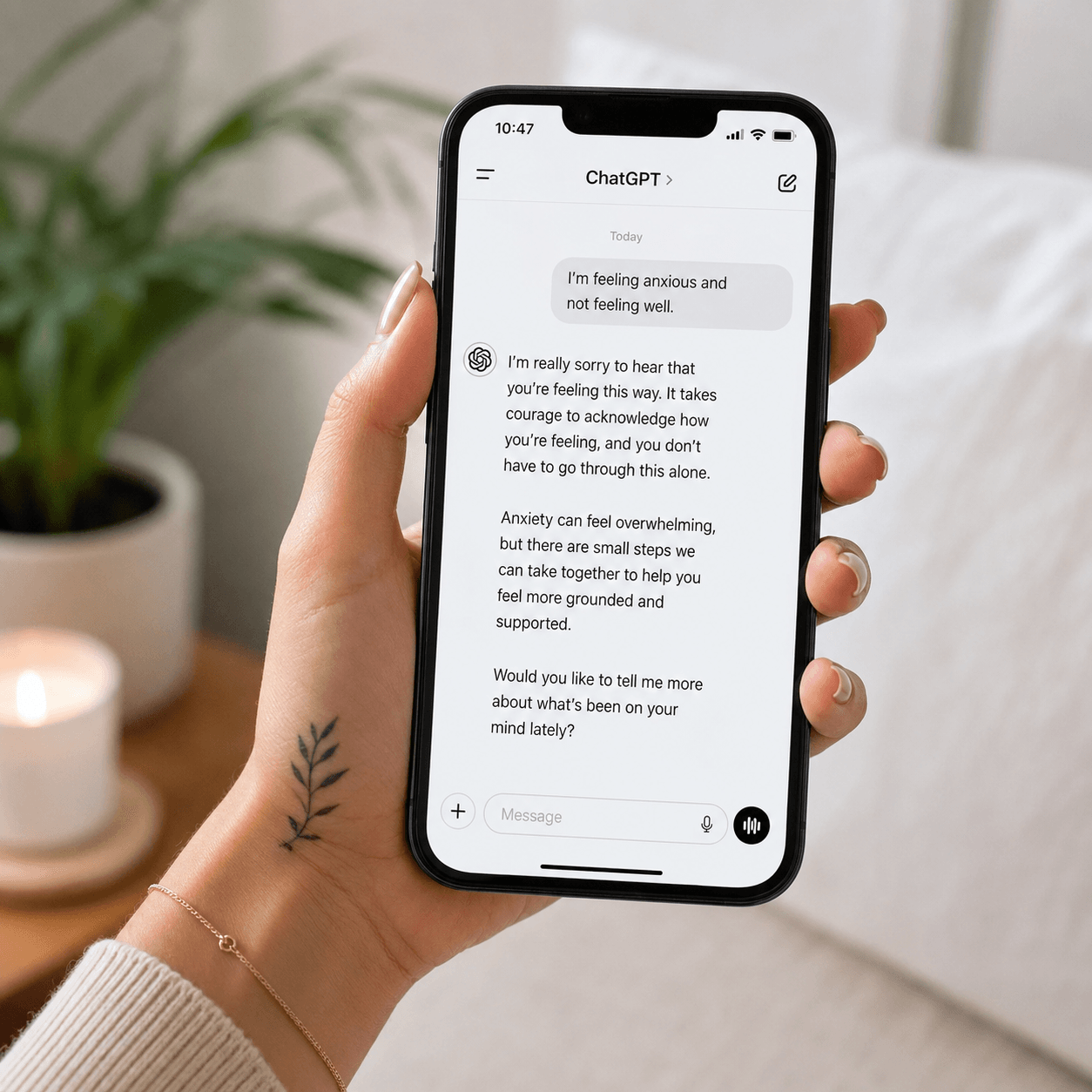
People use AI to answer health questions, organize busy schedules, brainstorm ideas, learn new skills, process difficult emotions, prepare for difficult conversations, and even help with their mental wellbeing. AI is now available at any hour, offering information, encouragement, and a place to organize thoughts when another person may not be immediately reachable.
This is real-time accessibility.
Mental health care continues to face significant challenges. Many communities have chronic service shortages, long wait times, financial barriers, and the continued stigma of treatment. AI may help to eliminate some of these barriers if it’s applied wisely, through education and healthy coping skills, assisting with preparation for appointments, and the encouragement to seek professional help when needed.
Some recent research suggests cautious optimism around AI and mental health. Studies show that conversational AI can promote mental health literacy, help people organize difficult thoughts, reinforce skills learned in therapy and make little improvements in anxiety and depression symptoms when it’s used alongside, not in place of professional care. Research also indicates people may develop a sense of engagement with AI (sometimes called a digital therapeutic alliance) that can help drive motivation and engagement in self-help activities. But experts emphasize that these tools are most useful as a complement rather than substitute for human care.
Like any powerful technology, the impact of AI is less about the technology itself and more about how we use it.
Just as we develop healthy habits around nutrition, exercise, or social media, we can develop healthy habits around artificial intelligence.
The healthiest relationship with AI is not based on dependence.
It is built on intention.
Think of AI as a Coach, Not an Authority
AI is incredibly good at explaining information, organizing ideas, translating complex language into understandable terms, and helping us think through problems.
It can explain a diagnosis in everyday language, summarize research, generate questions you can discuss with your doctor, help you organize symptoms before an appointment, or review coping strategies you have learned in therapy.
These uses are meaningful as they encourage engagement rather than passivity.
Instead of asking AI to make decisions for you, consider asking questions that help you become a more active participant in your own care.
“Help me understand this diagnosis.”
“What questions should I ask my therapist?”
“Can you explain these lab results in plain language?”
“What evidence-based treatments should I discuss with my doctor?”
Notice the difference.
AI is not replacing your healthcare team.
It is facilitating you to have better conversations with them.
Let Curiosity Lead
AI’s greatest strength is that of immediate answers.
Human beings hold one of the greatest strengths in asking thoughtful questions.
Healthy AI use means remaining curious.
Where is this information coming from?
Does it represent current scientific evidence?
Could there be another explanation?
What is missing from my history that AI doesn’t know?
Artificial intelligence generates responses based on patterns learned from enormous amounts of data. While those responses can be remarkably helpful, they are not the same as clinical judgment developed through years of training, direct observation, ongoing relationships, and knowledge of your individual circumstances.
Curiosity keeps us engaged.
Certainty can sometimes stop us from asking for help.
Use AI to Prepare—Not Replace
Imagine preparing for a medical appointment after weeks of unexplained symptoms.
AI can help to create a timeline.
It can organize questions.
It can explain unfamiliar medical terminology before you walk into the office.
These are the kinds of uses that can make appointments more productive because they improve communication rather than replace it.
The same is true for therapy.
AI is commonly used by many people to journal, recognize cognitive patterns, review mindfulness exercises, or practice communication skills between sessions.
In this way, AI becomes an extension of reflection, not a replacement for the therapeutic relationship.
Pay Attention to How AI Makes You Feel
Healthy technology use is not only about what we’re doing.
It’s also about what it’s doing to us.
Take a moment to ask yourself:
Do I feel more informed after using AI?
Has it encouraged me to connect with another person?
Am I using it because it’s convenient, or because I’m avoiding a difficult conversation?
Is it helping me solve problems—or helping me avoid them?
These questions are not meant to judge.
They are invitations to remain mindful.
Technology should expand our lives, not gradually narrow them.
Protect Your Privacy
Not every AI platform handles personal information in the same way.
Before sharing sensitive information, take time to understand how conversations are stored, whether data may be used to improve systems, and what privacy protections are available.
Healthcare organizations are increasingly exploring AI for documentation, scheduling, and clinical support, but transparency, informed consent, and strong data governance remain essential for maintaining trust between patients and providers. The World Health Organization has repeatedly emphasized that responsible AI use in healthcare must prioritize safety, accountability, and human wellbeing as these technologies continue to evolve.
Being thoughtful about what you share is part of healthy digital wellbeing.
The Question Isn’t Whether AI Can Care
As AI becomes more conversational, a deeper question emerges.
If technology can sound empathetic, what makes human connection so essential?
The answer lies in understanding what healing actually is.
Healing has never been simply about receiving information.
Most of us already know that sleep matters, exercise improves mood, mindfulness reduces stress, and healthy communication strengthens relationships.
Information alone rarely changes our lives.
Transformation happens in relationship.
We heal when someone remembers what we said weeks ago.
We heal when another person notices the sadness we’re trying to hide.
We heal when someone gently challenges us because they care enough not to simply agree with us.
We heal through trust that develops over time—through vulnerability, accountability, forgiveness, celebration, grief, and shared experience.
These moments cannot be generated from statistical patterns in language.
They emerge between people.
Validation Is Not the Same as Relationship
One reason AI feels comforting is that it is consistently available.
It is patient.
It rarely interrupts.
It often responds with empathy and validation.
Those experiences can be genuinely helpful, especially during moments of stress or loneliness.
But researchers are beginning to ask an important question:
What happens when validation becomes disconnected from relationship?
Healthy relationships ask something of us.
Friendships require compromise.
Families require forgiveness.
Therapy requires honesty, curiosity, and sometimes the willingness to hear something difficult.
Growth is often uncomfortable precisely because another person helps us see what we cannot yet see ourselves.
AI does not share a life with us.
It does not experience joy, disappointment, conflict, or reconciliation.
It cannot genuinely celebrate our victories because it watched us struggle.
It cannot sit beside us during grief because it, too, feels the weight of the loss.
It cannot build a shared history. More and more mental health professionals have recently been advising us about the promise and potential dangers of today’s more human-like AI companions. While these technologies can reduce loneliness in some people or even encourage self-reflection, we need make sure that we don’t get emotionally dependent or use AI as a substitute for real-life relationships. And the problem isn’t that AI is harmful by nature, but that convenience cannot replace connection.
Keeping Humanity at the Center
Artificial intelligence will keep getting faster and smarter and more ingrained in our world.
That is not something to fear.
It is something to approach with wisdom.
Use AI to learn.
And use it to prepare.
Use it to organize your thoughts.
Use it to ask better questions.
Use it to reinforce healthy habits.
Use it to expand curiosity not certainty.
But let your best conversations be with the people that know your story and celebrate your success, point out your blind spots and be there when life becomes difficult.
If AI is useful for us in making us all more educated, more reflective, and more willing to seek help, it’s done what it was supposed to do.
If it’s use would take away from our willingness to engage with real people, or to accept vulnerability, or to participate in community, we risk losing something far more valuable than convenience. We risk losing ourselves and what it means to be human.
The future of mental health will almost certainly involve artificial intelligence.
The future of healing will always be about human relationships.
Technology could light the way.
Only people can walk it together.